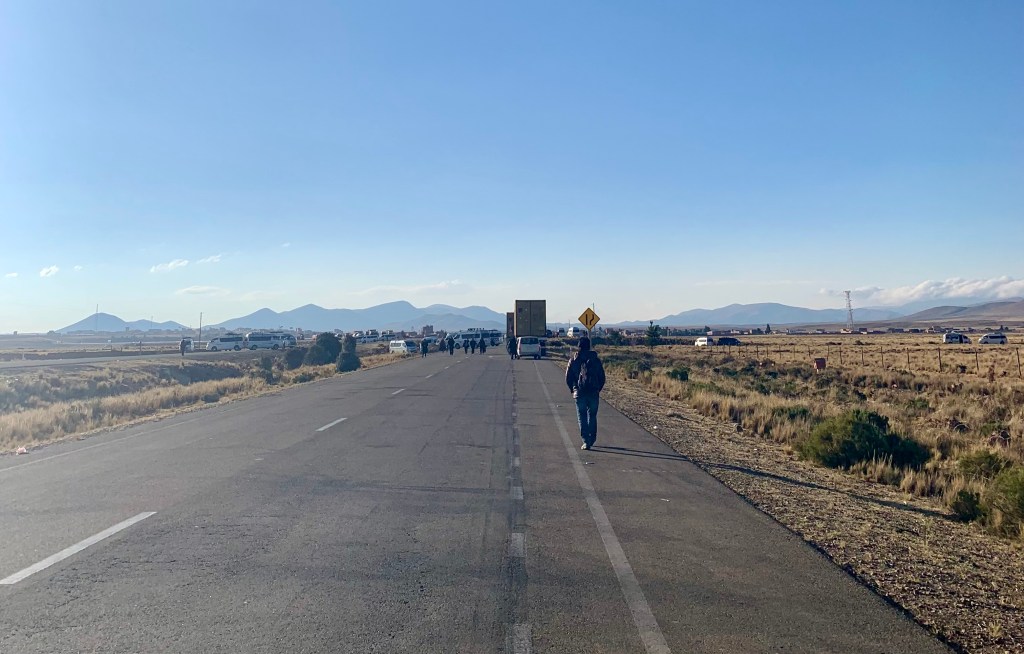
Slithering through parked buses and cars, we headed out of the city. My tote crept down my shoulder every time I was jostled by craters on the packed dirt road. This was a motorcycle ride of utility not reckless bliss, I was trying to evade the mini bus blockade that stopped all passage out of Oruro.
I’ve been hearing ominous warnings about blockades in Bolivia since my initial arrival in December. The blockades (there were two about about 30km apart) were nondescript. I didn’t register them as blockades initially: a conglomeration of white mini buses parked together, granted in the middle of the road.
Mini bus drivers are protesting a lack of diesel in Bolivia. At the root of the gasoline scarcity is the dollar, namely the lack of them. Dollar scarcity is mainly due to the Bolivian government’s importation of fuel, while domestic natural gas production and exportation has slowed. The Boliviano’s instability led many people, beginning in 2020, to exchange their Bolivianos for dollars and stockpile large amounts of the bills. Every conversation I strike up on a trufi or taxi turns into a conversation about dollar scarcity, definitely heightened by my Americanness. In April and May, I was aware of the scarcity from news articles, but strangers didn’t openingly want to talk about the issue.
While waiting for a bus to La Paz in Caracollo (after passing two stretches of blockades), I felt silly reflecting on my initial motorcycle hesitation as I watched a mom put her baby between herself and the driver, while her partner hopped on behind. They had a wobbly start, but quickly found traction. It was a successful mission too—the motorcyclist came back merrily 7 minutes later. Gradually on my own ride, I became more comfortable, even riding with my hand on my shoulder to stop the tote slippage. Diego seemed to sense this ease and cranked the last kilometer of flat paved road; my feet were shaken to sleep from the furious pedal vibration.
Since I’ve been in Bolivia, there has been a lot of talk of blockades, “No hay pasó, hay bloqueos” is something I’ve been accustomed to hearing when trying to figure out travel plans, the most dense blockades this past February leading up to Carnival. As the Bolivians I consulted with predicted, the blockades were taken down just before the festival, something I was skeptical of initially—in the US big events are usually the targets, rather than a reason to ease demonstrations. But the pressure to celebrate and income from the event were highly regarded—a settlement was reached and the party raged.
I asked Jesus, who I took a taxi with from the motorcycle drop off point, if the blockades are common, “yeah of course, if the price of bread rises, they’ll have a blockade.” Bolivians I’ve talked to often scoff at the organizing, some have even apologized for the state of their country. To me, someone without money on the line who was granted the opportunity to explore Bolivia, the drop everything and protest mentality is fascinating and also sort of inspiring.
An older gentleman from Caracollo came down to the bus departure strip just to watch the residual blockade action. “Yeah, the blockades are pretty normal,” he told me as he looked on. The blockade fallout was quite entertaining, a sentiment shared by participants and onlookers alike: a crowd of us waited, hoping to get onto already packed buses that passed by. Cholitas lead the charge, sprinting and knocking on the doors for encouragement, laughing while they did it, while the rest of us followed their lead. Ultimately one of the buses came to a rolling stop and I managed to hoist myself up while the bus took off. Initially I got comfortable in the aisle, but a gentleman cleared some foot room and offered me the spot. I happily took it.
While sitting there, cramped in the foot space, I wondered what the people already on the bus thought about our party clambering on. Did they feel annoyed that the bus was stopping when there wasn’t space? Were they sympathetic, maybe they had to all fight for their spots on this bus when the blockade cleared? Did they laugh as we raced desperately towards them? I couldn’t tell.
Looking around, it was hard to believe how normal everyone seemed in their seats listening to music, dozing off; I was grateful to even have a ledge to hunker on, while the rest of my party stood on the stairs. The older gentleman’s joke about needing to live in Caracollo because the bus would never come wasn’t exactly assuring.
In Oruro, taxi drivers mentioned that the blockades were only around the city, everywhere else people were having a regular day. While in it, all I could think about and physically deal with was how to get out of the blockade; the awareness that everyone else was unaffected, felt odd and unsetting. It reminded me of getting caught in torrential downpour on my bike, then falling off in an attempting to go over a slippery curb, and showing up to brunch bloodied and drenched. My friends who I was meeting were dry and surprised at my wretched state, while I couldn’t believe they didn’t even experience a drop of my intense reality. Isn’t that the thing with external experiences, shouldn’t they bring people together through the attempt to manage? Clearly not when only hotspots are targeted, which still feels hard to wrap my head around, though intellectually I guess it makes sense.


 Lucy Jackson
Leave a reply to Anonymous Cancel reply