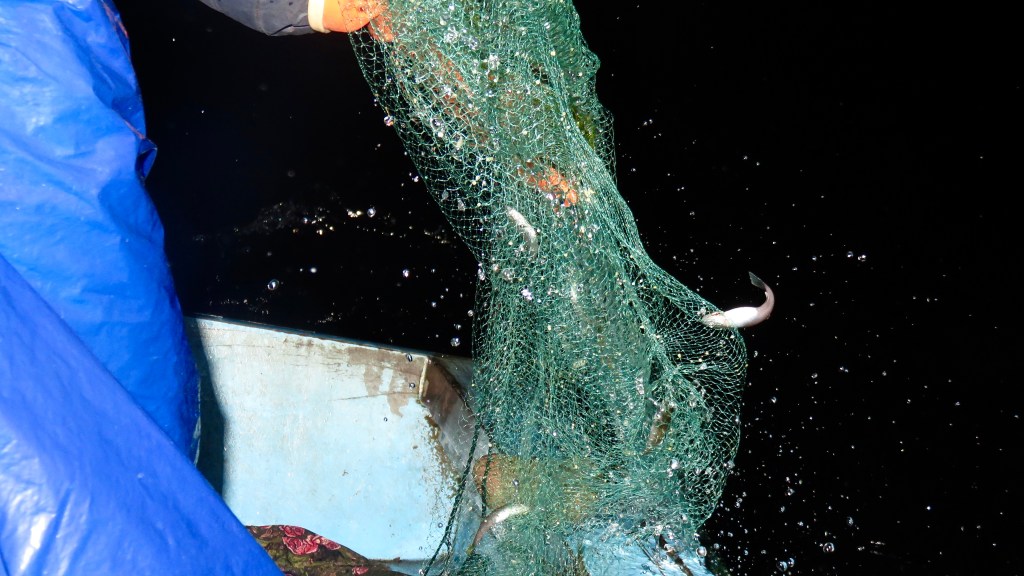
It was 4:27am and I was in a half slumber when I heard Esperanza’s zapatos de cholita (similar to ballet flats) clacking on the concrete outside the room where I am staying. “Lucy?” she called. “Puedo encender la luz?” “Si,” I said as she turned on the light and I tumbled out of bed. I put a pair of pants over the silk long johns and pj pants I wore to bed and a fleece hoodie and wool sweater over my turtleneck, then a hat, a scarf, and finally my puffer. When there is no sun, it’s cold on La Isla de La Luna, especially in the early hours when the wind is strong.
I met Porfirio down by the water. He was already in his wide blue rowboat with a motor attached to the stern. Porfirio was also bundled with two down jackets, a hat and scarf, rubber boots, orange rubber gloves, and a blue plastic sheet wrapped around his waist. I was meeting him to bring in his ispi nets, a wiggly silver fish about 3 centimeters long, that he has been catching since he was 12 years old. We pushed off from shore equipped with light from the stars, the waning moon directly overhead, and our headlamps refracted and absorbed by the lake.
Porfirio drove the boat out past the tip of the island to the other side where he had dropped his nets the evening before. The dull rumbling of the motor and fierce crashes of waves against the sides of the boat carried us forward; I managed to get some airtime sitting at the bow.
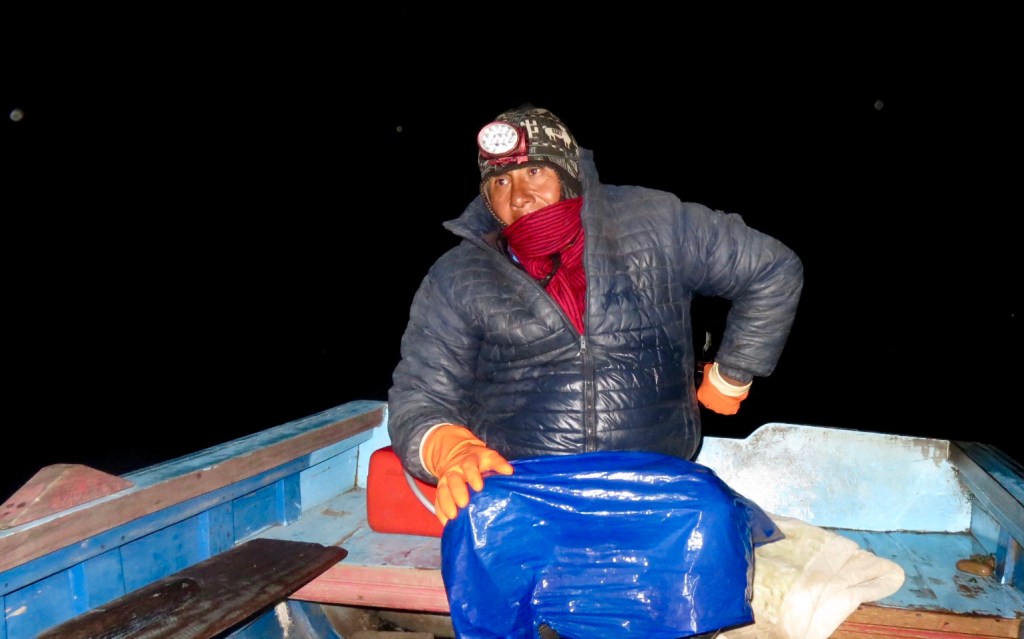
When we arrived at the other side of the island, Porfirio looked out into the lake headlamp a blaze, searching for signs of nets. We circled in on a floating water bottle; I thought it could be trash someone left. Porfirio released the motor, which continued to murmur, and grabbed the bottle while standing in the wobbly boat revealing the fishing line attached to it. He remained standing and began pulling and wrapping the fishing line around the bottlet, first with ease and later with slow motion pulls due to the weight that followed. The lines are long, and the nets are longer; about 20 to 25 meters. They sink to the bottle of the lake thanks to rocks attached to one side. The other side has small triangular floatation devices so the nets create a wall for the ispi to swim through. The holes in the nets are the perfect size so that when the ispis try to pass, their heads get stuck in the nets. They’re called gill nets for this reason.
During the rainy season when ispi and frogs are abundant, frogs get caught in the nets too. On the island, catching a big frog in your net is a sign that abundant ispi will follow, while a small one means that the ispi population will be diminishing. Frogs were once abundant, now they are rare and in danger of extinction.
Porfirio has 11 nets, and one by one we scouted more water bottles whose nets and lines he pulled, spooled, and piled. It’s hard work bringing in the lines; it takes about 3 minutes to pull one in. While pulling in the lines, Porfirio piled the nets in a square cloth on the seat at the stern. When the net ends, which it eventually does, Porfirio secured a cloth around the net, making a sack, occasionally having to tuck in an ispi that wiggled free. The ispis are initially alive, but quickly die out of water. All the while, the sun began to rise. By the time he finished pulling and spooling, there was a mustard yellow line behind the mountains on the horizon etching and expanding up.
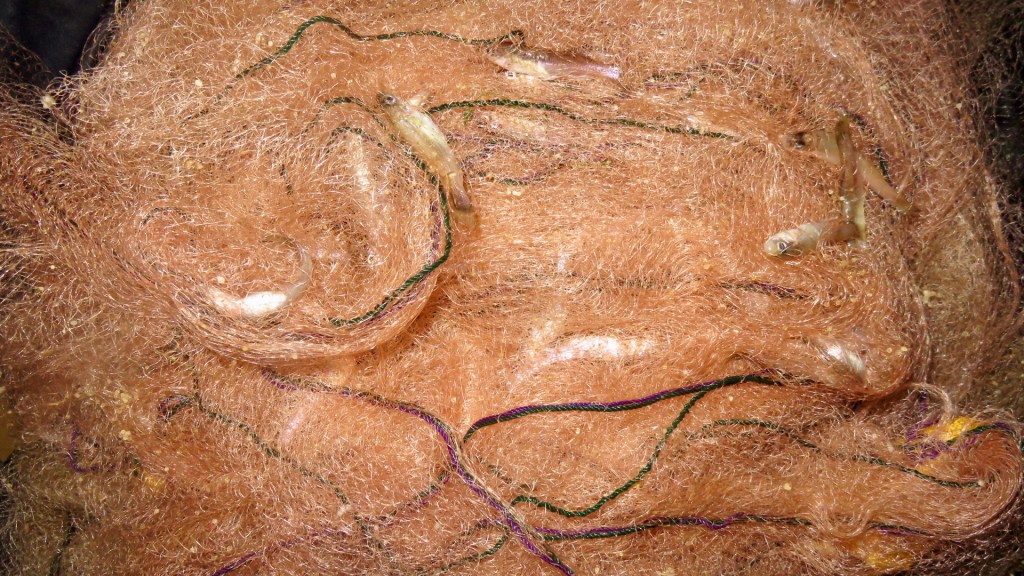
We headed back at 6:08, right on schedule according to Porfirio. Esperanza was waiting and caught us when we arrived on shore. We brought in the nets, and then began to untangle the caught fish. I sat with Esperanza who shook the net to dislodge the ispis onto a bigger net on the grass, while I held the other side to keep the nets taught. Occasionally an ispi got itself real good and stuck, so the shakes wouldn’t cut it. Initially I tried to dislodge them tenderly to avoid decapitating them—their fragile smooth bodies didn’t feel like something I wanted to break. This technique was not effective in letting them free, a good yank is required, Esperanza and Porfirio told me. The fish were mostly intact, though sometimes strange appendages formed on their little bodies due to the constriction of the nets. In my yanking strategy I only decapitated one.
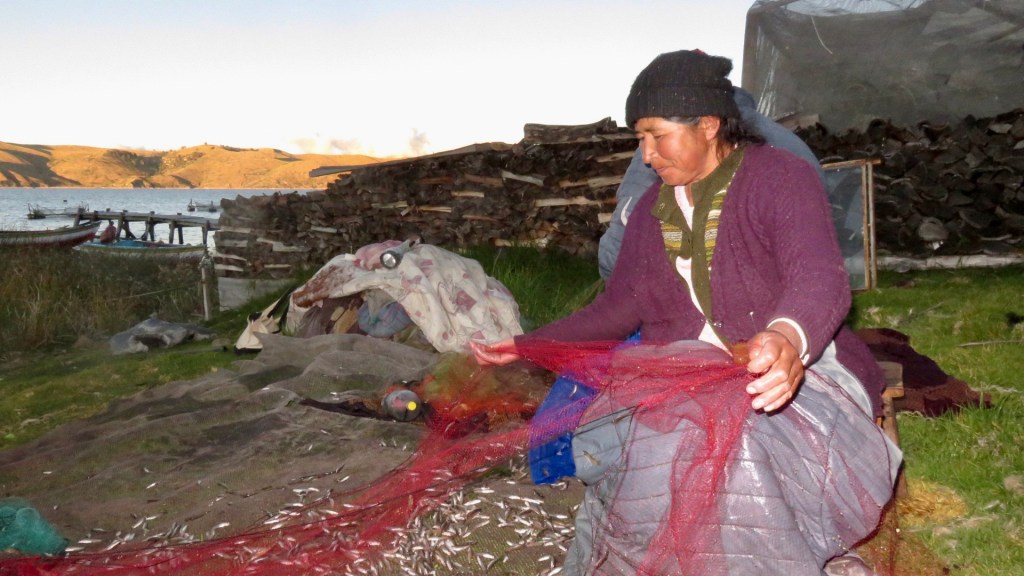
Liseth woke up early and joined us; she and Porfirio began the same shaking process I was working on with Esperanza. My hands were cold and stiff from the wet nets and unspooling them had the same perpetual feeling as watching them emerge from the lake before. When all the ispi were free and we were beginning to gather them, Porfirio pointed at his collarbone and said to me, “tienes un ispis aqui.” I looked down, from all the flinging I had acquired a lovely ispi pendant. I laughed and tossed it with the rest, I was in the ispi zone.
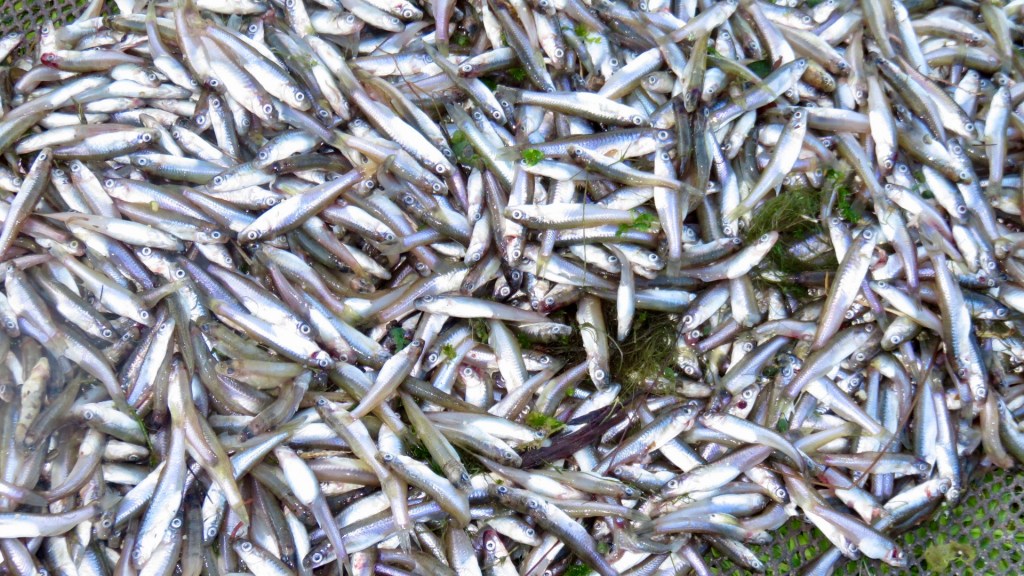
Esperanza washed the fish and put them in a 5-gallon bucket, filling it two thirds of the way. She said we had a “cuatro lata” or about 15 libras. She is going to batter them in a flour and salt mixture and fry them to serve tourists with pasta and potatoes.
When we finished with all the nets it was 7:26. I washed my hands in the frigid lake water which felt warm to my swollen hands. I started feebly clacking on my computer at 7:38; my hands still red, tingly, mildly cramped, smelling like fish and algae, with small silver scale flecks. My red puffer aquired the same ispi shimmer too.


 Lucy Jackson
Leave a reply to denhogan Cancel reply