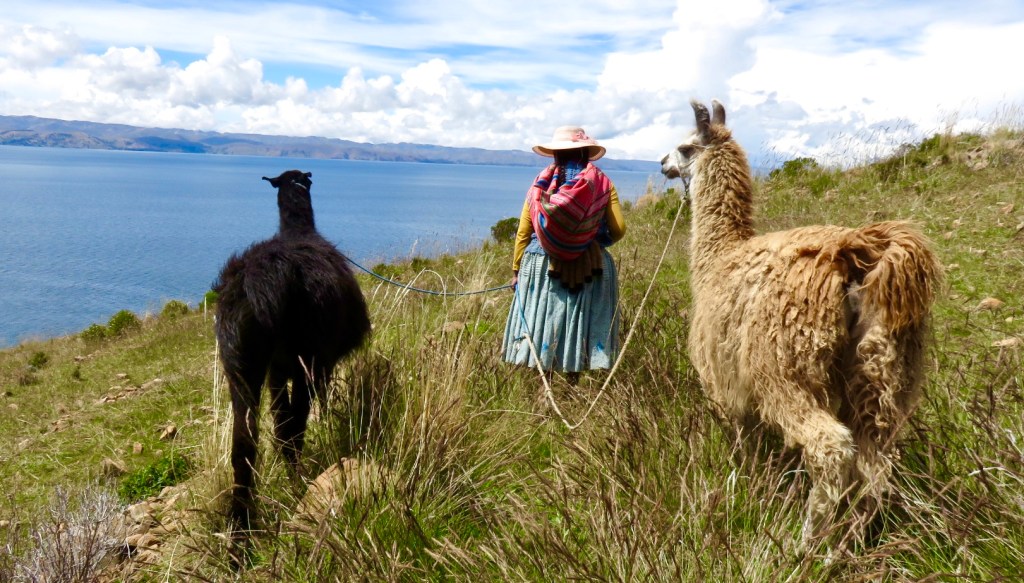
I have been on Isla de la Luna for the past two weeks living with three generations of Mamanis: Esperanza and her husband Porfirio, their daughter Dania, and her three children Lizeth, Aena, and Liam. I am often pulled (usually physically by the hand) into the little ones’ activities and am an honored and eager participant. Yesterday we spent a good hour investigating the snake carcass a member of the community killed and then burned for protection. I have also happily taken on the role of Liam’s interim babysitter; he is 5 months old and likes to be on be bounced or on the move.
The Koati community, made up of 27 Aymara families, live on La Isla de la Luna. I am living here collaborating with Bolivian Amphibian Initiative, founded with the mission to prevent extinction of amphibians in Bolivia and currently working with the Koati community to create a sanctuary for Lake Titicaca’s giant water frogs, Telmatobius culeus. The frogs are unique to the lake and once abundant, but now in danger of extinction. The dwindling frog numbers are due to several factors: the introduction of trout (suggested by the US in the late 1930s as an additional source of protein) who eat the frog eggs and tadpoles, runoff from mining, chytrid fungus which damages the frog’s skin, and dishes like caldo de rana, a frog soup. With the help of BAI and the generosity of the Koati community, I am learning about Aymara women’s frog and toad perceptions and beliefs, while on the lookout for some of the sacred cuties too.
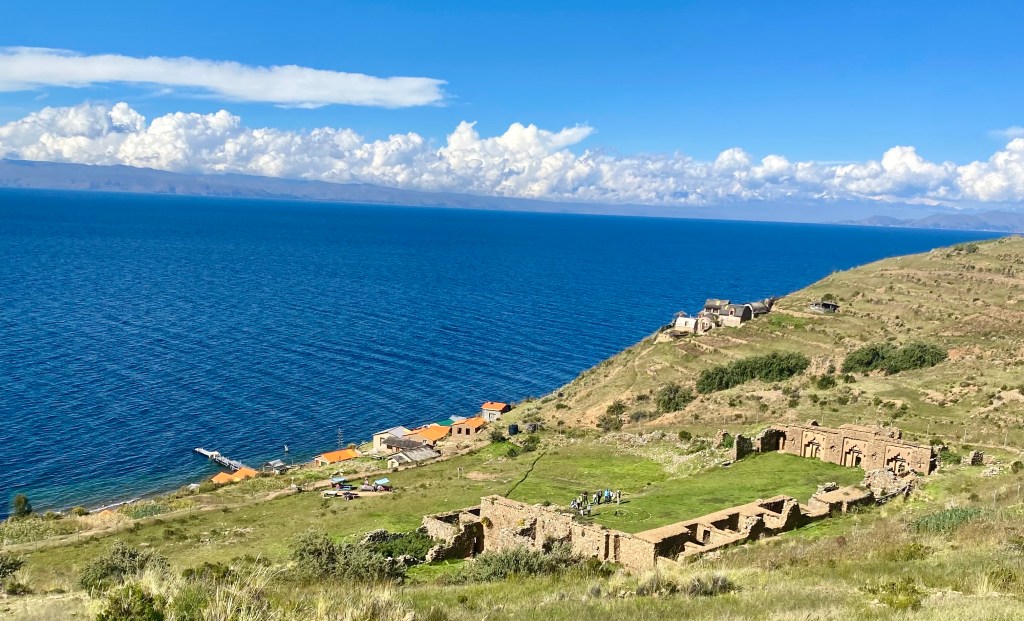
So far, I have spotted two Sapos Espinosos Andinos Rhinella spinulosa during evening toad quests. One was on the path to Ajllahuasi, el Palacio de las Vírgenes o templo sagrado de Iñac Uyu, previously the residence and school to young, elite Incan women, learning medicinal medicine, weaving, and moon rituals. The Aymaras lived on the island before the Incas and have since incorporated the temple into their own cultural practices. In Aymara cosmovision, the moon guides the divine feminine and is essential to understanding perceptions of time. The Aymara calendar has thirteen months, each with 28 days, beginning with a new moon and ending with the full, following the same cyclical pattern as menstruation.
Today, the area outside the temple is where Koati women sell hand crafts to tourists passing through on 50 minute tours en route to Isla del Sol, the bigger and more developed island. The women sell long macrame belts (always on hand in progress) and other goods from La Paz and Peru.
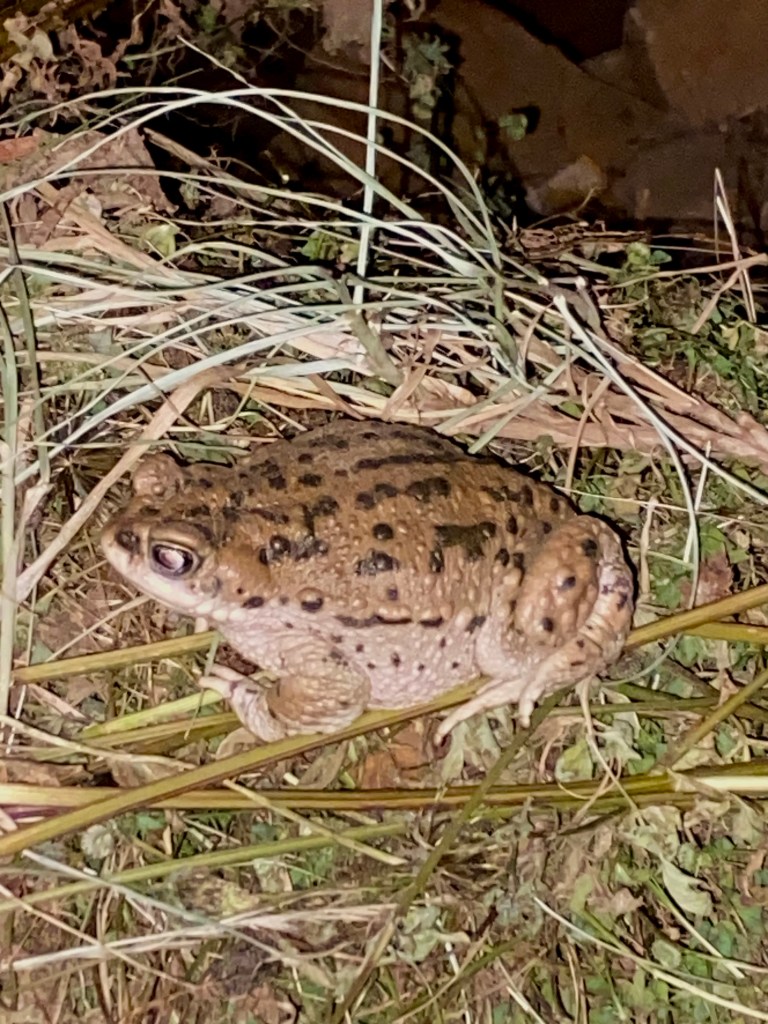
The second toad I spotted was on Esperanza’s property where I am staying. When I told Esperanza about the toad I found, she excitedly said, “Maybe the toad that Don Francisco stole has returned.” She decided to keep the pile of cut grass where I found the toad because she thought it might live inside and “el sapo es dinero” (the toad is money).
I first heard the story of the stolen toad from Adi, Esperanza’s daughter who studies tourism in La Paz (Bolivia’s political center and about 3 and half hour drive from the mainland). Adi told me that there used to be a giant toad that lived on their property which she encountered at dusk. She told Don Francisco, her neighbor who also has a hostel property like her family, excidely about the toad—this was before she knew that toads are a good luck charm. After hearing Adi’s story, Don Francisco said he would take the toad for himself, which Adi interpreted as a joke. But sure enough, Adi watched him pick up and carry the toad to his home.
When Esperanza found out what had happed, she told Adi that her luck was stolen. According to Adi, Esperanza’s hypothesis has been true; since the robbery Don Mario and Dona Maria have been more “successful” than the Mamani family. The evidence: before only Esperanza sold ispi (a small wiggly eel like fish served fried and battered in flour) now Maria sells ispi too. Maria also has a property with a higher lookout, furnished rooms, and advertises her accommodation on Bookings, so tourists can easily reserve their stays. I have watched Esperanza look on while groups of fair skinned backpackers climb the stairs to her neighbor’s property. I can see how stolen luck in the form of a toad could be indicative of other dynamics of competition and loss too.
Lake Titicaca’s giant water frogs are also a symbol of prosperity for the Koati community. They are seen as the guardians of the ispis (though they also eat them). The Koati community believes that when a fisherman catches a giant frog in their net, more ispis are imminent. Since I have been here, no one has caught any frogs in their nets and the Ispi are sparse.
In times of drought, the frogs are used to summon rain. Usually in September, October, November, when seedlings are fresh and rain most important, a giant frog might need to be acquired. There are three “cavernas” at the top of the serpentine mountain spine, that are used to make offerings to ask for rain. If offerings of coca, alcohol, and sweets are not sufficient for Pachamama, the community places a frog in a container of water and hopes for rain to answer the frog’s cries.

Beyond tourism, sheep and llamas are another source of stability for the community. Esperanza’s family has 18 sheep and three llamas, one llama a new acquisition since I have been on the island. The animals require daily “pasteando,” the process of watching them graze through the rocky cliffs that make the island’s snake spine curve–there is a local legend that the island was once a snake that lost its head in battle. The sheep know the way; they slowly eat along the rolling coves on the side of the cliff as Esperanza watches them, usually also working on a macrame belt. Only the slow babies require a “shheech” to get them on their way—in particularly stubborn moments a thrown rock moves them along.
While pasteando, we usually also pick vegetables for lunch and dinner from the robust fields along the sides of the cliff. There is “choclo” large corn, “habas” big green beans, “papas” potatoes, eggs from the chickens, and fish from the lake. With these core components Esperanza makes soups and dishes with the steamed vegetable and fried fish or eggs. Everything is fresh, tender, and sweet. Next week we are going to start “escavando las papas” to begin the process for chuno, a freeze dried Andean potato that the people of the Altiplano have been making for centuries. In the meantime, I am going to keep searching for frogs and toads and collecting stories of mystery and miracles past.


 Lucy Jackson
Leave a reply to weatherprincess Cancel reply