On New Years Eve, I arrived in Santa Cruz in a daze after failing to sleep through a passenger’s plan to monopolize Bolivia’s honey market. Thanks to a hectic passage through customs, I left Santa Cruz for Cochabamba with a Visa for Lucky McGill Jackson. Migration officers booked me a room (that we all knew I would never use) at Hotel Viru Viru II since no credit card was required and that establishment was considered a more suitable address than that of my Spanish school. I am choosing to interpret the typo as a stroke of serendipity, I am officially Lucky.
Jacques, who runs Escuela Carmen Vega with his wife Carmen, drove me to Magui’s house, my host while I take classes. When we arrived, Magali, Gaby (Magui’s daughter), Jacques, and I drank trimatte (tea with anise, chamomile, and coca) with the black walnut chocolate chip sourdough banana bread I whipped up the morning before my flight. I then passed out for five hours and woke up eager to get outside. “Camina por la laguna, es muy cerca,” Magui told me.
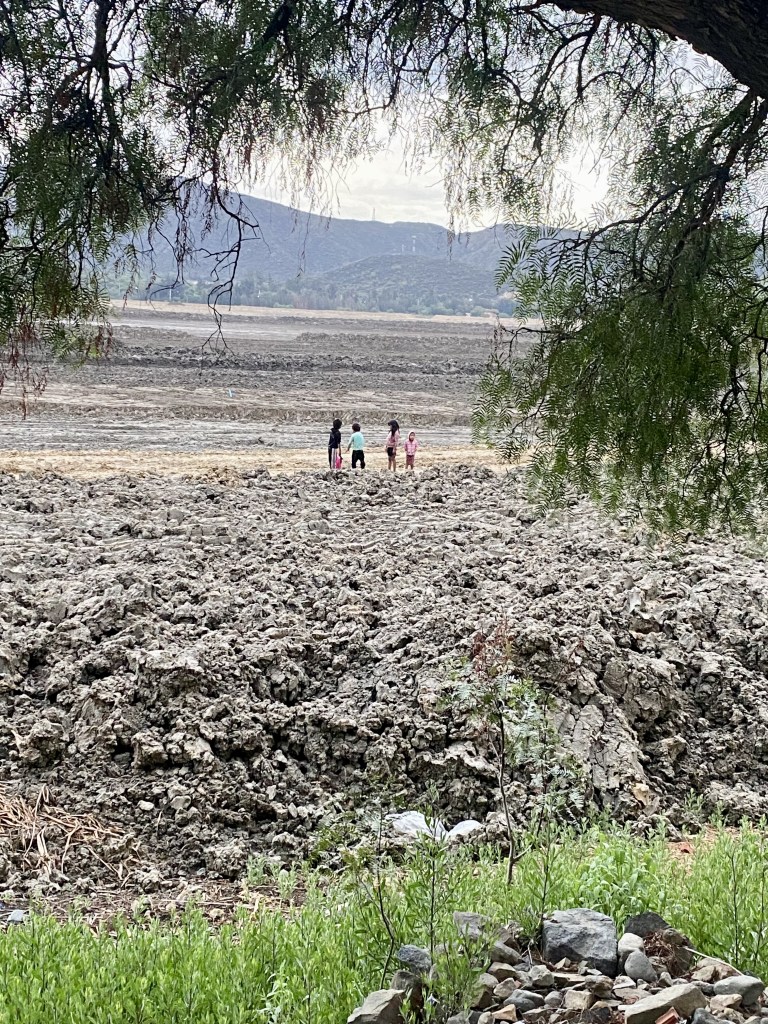
I decided to start my journey in Cochabamba because I wanted to work at the K’ayra Center (a frog conservation lab) while refreshing my Spanish. One of the many reasons I was excited about La Escuela Carmen Vega was because it is close Laguna Alalay. I hoped to find some frogs and thought the lake would be a nice friend to walk beside as I tried to start thinking in Spanish. However, on the ride from the airport to Magui’s house, Jacques told me that the lake was completely dry. The cracked beige ground was a surprising contrast to the big blue lake identified on Google maps and tagged photos. On my walk, I wandered out onto the crusty surface until the sandy ground turned into high suction mud which yanked down my shoe before I could pull away. Then one of the street dogs from the pack who now inhabit the open turf started charging and barking towards me. I decided it was time to rein it in and stick to the path, I had a lot to learn about this new terrain.
It started to rain when I got to city. I didn’t have a rain jacket and decided finding one could be a good first quest. I whisper-rehearsed my question as I approached a group of men eating brothy soup with potatoes and meat protected by an awning. “Hay una tienda donde puedo comprar una chaqueta de lluvia?,” I asked them in timid/trying-to-seem-confident Spanish. They stopped eating, stared at me, and then one person started giving me directions, thankfully also pointing straight ahead as he spoke.
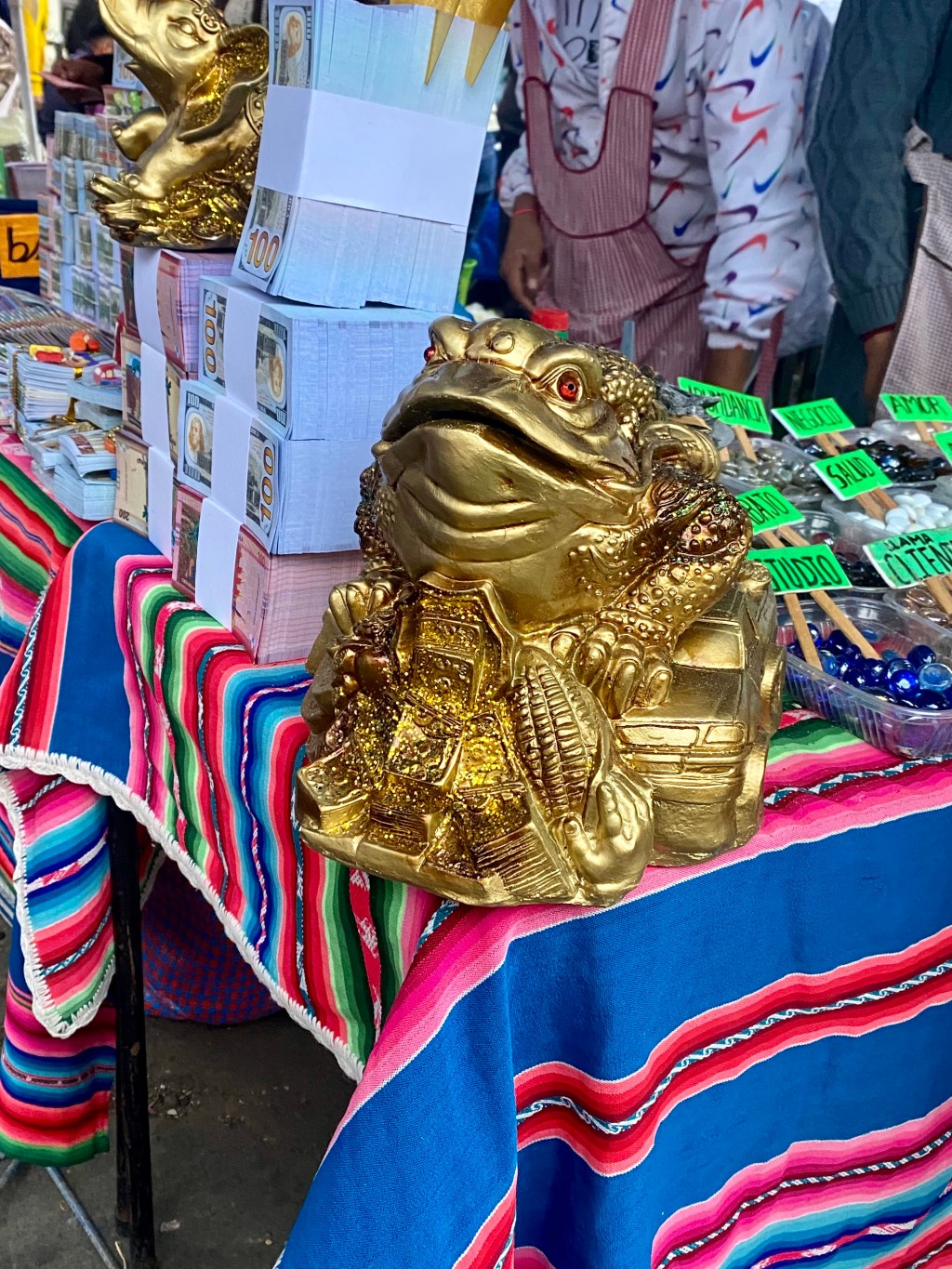
He directed me to La Cancha on Avenida Aroma where I met stacks of bananas so high and wide that they completely obscured storefronts, streets full with cyan potato bags, mountains of grapes (for the Hispanic tradition to eat 12 grapes and say 12 wishes at midnight on New Year’s Eve, one for every month), and a slow moving pickup truck with piles of meat cuts and three teenagers weighing out slabs in the back for the customers trailing behind. I got caught up in the market and the rain stopped, so I paused my rain jacket mission. The section I stumbled upon next sold the essentials for the k’oa, an Andean reciprocity tradition for Pachamama where participants burn small figures and tokens like fake money and houses to request the real life version in the coming months.
The first sapo (toad) I found was in this section, sandwiched between stacks of fake 100 dollar bills, incense, and marbles. It had gleaming ruby eyes and sat on a throne of gold, jewels, and choclo–a variety of corn with massive kernels used in soups and humintas, similar to tamales. The second was mounted on a pile of coins and also held a necklace of coins in its mouth. Carmen has a small silver version of the gleaming statues in her classroom. She told me the fat, rich toad statues sitting menacingly on their spoils are a totem of luck–the toads represent Pachamama. Carmen’s simple explanation is that toads and rain go together during the rainy season in Bolivia, and with rain comes bountiful crops, which brings food and money. For people in el campo (rural areas) who are predominantly Quechua or Aymara, the connection to los sapos, La Pachamama, and material success is direct.
In the city of Cochabamba, these seasonal economic connections are not as concrete. There is a more open symbolic and metropolitan approach to material success, shown in the plethora of good luck charms at the tables for the k’oa. For example, the Japanese Maneki-neko (the beckoning cat) who I recognized from the entrance to the Chinese restaurant Golden Dynasty, in my hometown in New York, sat perpetually waving among the toads. There were also golden elephants from India and green Chinese dragons. Dried dead baby lamas, a k’oa essential in Bolivia, hung on strings above the table of luck. However, the most abundant symbol on the tables was the frogs and toads, both with wide open mouths waiting for cigarettes and small ones, sitting on stacks of cash.
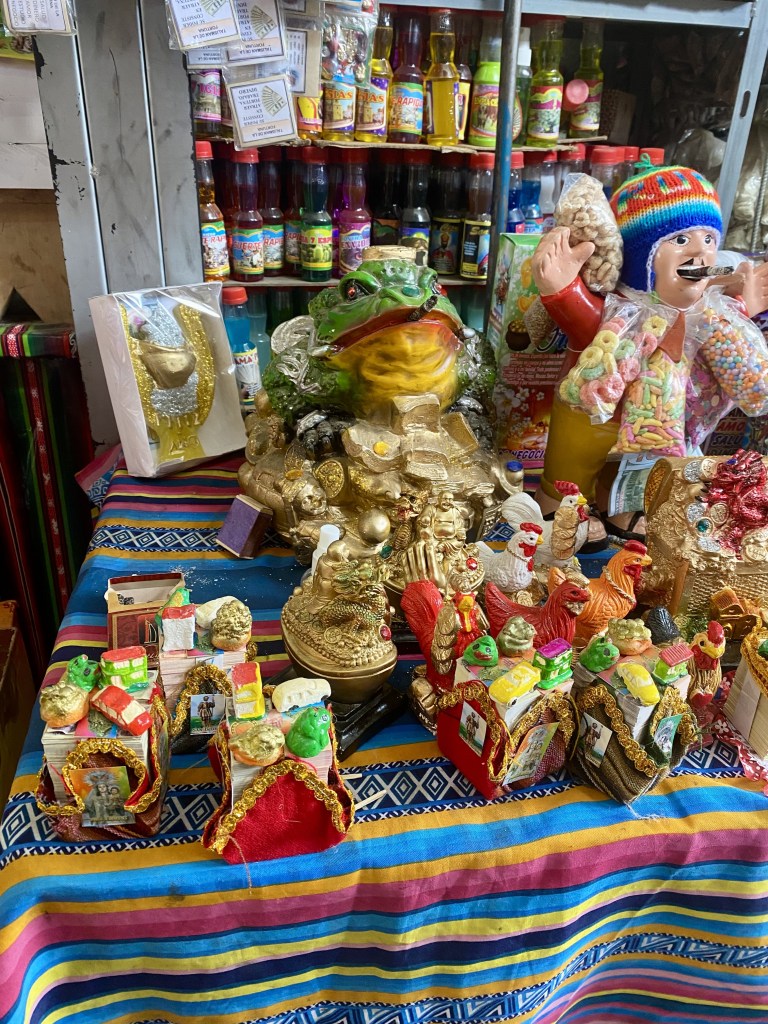
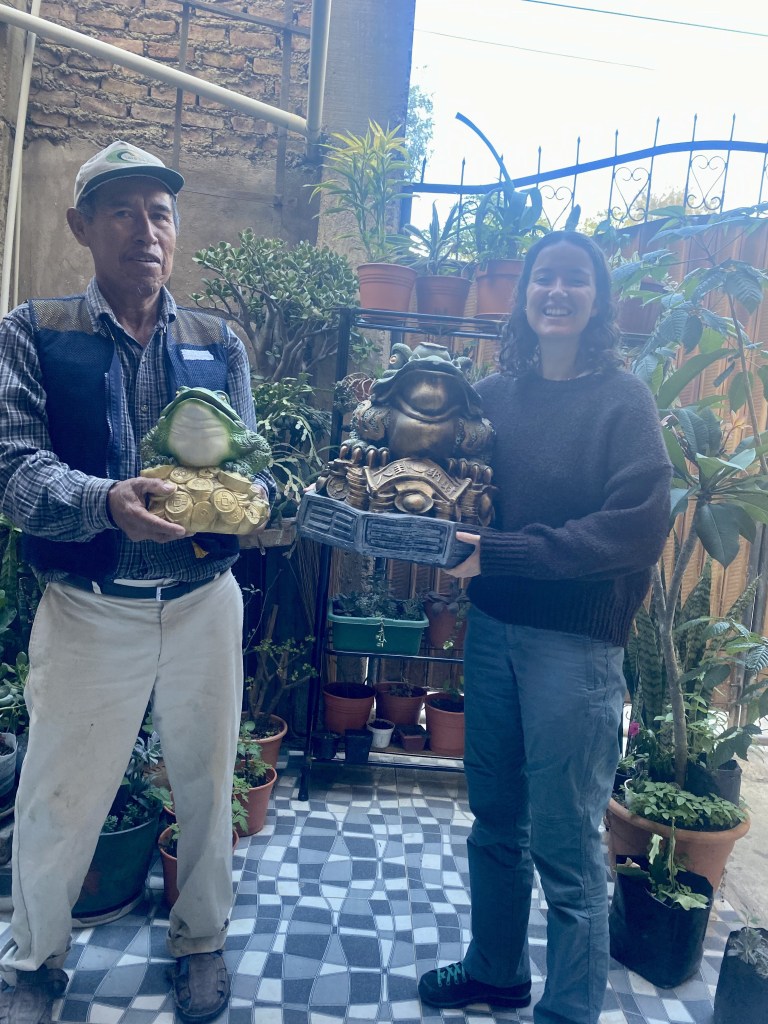
I learned from Daniel Arispe, who hosts students from La Escuela Carmen Vega like Magui, that the majority of the frogs I saw in La Cancha are Jin Chan or money toads from China. Daniel has two of his own, the biggest I have seen here, which he bid for and won at parties in Potosi, the mining center of Bolivia. Unlike the Bolivian frog with four legs, the Chinese frog has three legs, two in front and one hind attached to its rear. To welcome more riches, you are supposed to put a coin in the frog’s mouth and keep it pointed towards entryways to facilitate the inward flow of money.
These slight differences are interesting because though the toads’ origins are geographically distinct, the cultural integration of the figures in Bolivia and the perception of their significance remains largely the same. Ricardo Cespedes, director of the Natural History Museum “Alcide d’Orbigny,” where the K’ayra Center is based out of, explained that the frogs in La Cancha, “son replicas de Chinos. ” Ricardo hypothesized that in Bolivia they made molds of the Chinese money toad so they could easily cast the figures “porque es facil sacar el molde y comenzen reproducida aqui. Y creas un nueva ambiente cultural. No es ni Chino y hace vuelvo a Bolviano.” Ricardo called the adoption and immersion of the Chinese frog in Bolivian culture “simbioses actual,” the process where “la tradicional antigua estas haciendo absorbida por las cultura externas, las culturas que vienen.” This blending and absorption can be so subtle that Jacques, Carmen, Magui were all surprised to learn from Daniel that both the frogs at his house and the silver toad that Carmen used to explain the significance of los sapos in Bolivia was a Chinese toad, not a Bolivian one.
K´ayra is the Quechua word for water frog and at the K’ayra Center they focus on protecting and breeding endangered Telamtobius frogs (water frogs), from Lake Titicaca. Most of my work at K’ayra is about food: feeding the crickets, cockroaches, and beetles cut up oranges, apples, cucumbers, and carrots, and then collecting some of these well fed insects to feed to the frogs. The frogs from Lake Titicaca are my favorite. They have a boxy torso with an abundance of thick spotted skin. These frogs only live underwater, so their extra rumples provide more surface area for respiration. When the frogs are hungry, feeding them is real fun. They usually hunch down in a springboard position and lurch upwards towards the worm or grub I am dangling just above their faces with tweezers. If the frogs can’t see the tasty morsel, they direct their attention to my dark gloves, which remains a challenge to not jump at in response. When the frogs aren’t hungry, it’s a practice in patience and acceptance–you can’t force a frog to eat no matter how wiggly you make the gooey decapitated grub. If the frogs go statue mode, it’s game over, they won’t budge an inch.
There are also frogs near Laguna Alalay, just like I hoped. I first heard them on a evening walk with Magui and her dog Luna. When we passed a canal in between the lake and our path, Luna bolted towards the murky water and Magui called her away. Luna obeyed and we kept walking. Then Magui paused, “Escucha, son las ranas.” We stood on the path, heads tilted and ears pointed toward the canal listening to the chorus of chirping and croaking until Luna peed one single drop and kicked up some dusty ground which the frog’s interpreted as the conductor’s que to silence. I was giddy for the rest of the walk, so excited to hear these chirps of life!
The sparse in between that the frogs now inhabit is very different from pre drought conditions. Magui and Carmen told me that in Cochabamba in 1990, there was a “plaga de ranas” from Laguna Alalay. There were so many frogs that they lined the streets and the sidewalks, their croaks a never ending lullaby. With the abundance of frogs came squashed remains left by cars, and trucks, and clomping feet on the streets and sidewalks, Magui recalls, “habia un olor horrible!”
Though Magui thought the “plaga” was disgusting, she would never kill a frog for fear of Pachamama’s retaliation. Magui’s father-in-law stepped on the frogs as he walked, a grave mistake she told me. He got sick afterwards, which she attributes to Pachamama punishing him for his recklessness. Carmen’s brothers suffered a similar fate after going on an adventure to a nearby pond where they caught and killed the frogs there. In the evening when they returned from this escapade, they had terrible fevers. Doctors at the hospital couldn’t find anything wrong with the boys. However, when Carmen’s mother finally found out what they were up to during the day, she jumped into action–she scolded her sons for taunting and disrespecting Pachamama and assembled a k’oa to ask for forgiveness from the boy’s naive cruelty. “Y por la mañana, estaban bien,” Carmen told me.
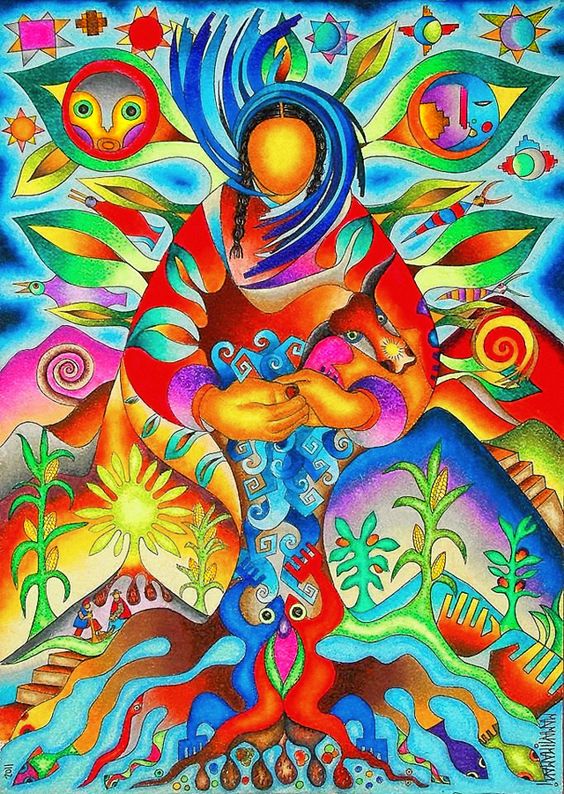
The connection between Pachamama and frogs and toads can be seen in one of Roberto Mamani Mamani’s most famous paintings of Pachamama. Jacques referred me to Mamani Mamani, an Aymara artist from Bolivia based in La Paz who centers Aymara cosmology through his use of bright colors and traditional symbols. On the bottom of his painting, Mamani Mamani depicts a red and blue toad with legs reaching down like roots and hands breaking through the Earth’s crust to lift up Pachamama. Through this symbolic representation, Mamani Mamani shows the toad’s liminal zone of existence in Bolivia: they are Pachamama’s anchor underground and visible on the earth when the land is most fertile and Pachamama is most present.
Though frogs and toads are symbolic of Pachamama, in Cochabamba many perceive them as ugly or a cause for fear. Usually, the initial reaction when I explain my project is intrigue and mild amusement, “ah, las ranas! No tienes miedo?” After a bit of probing, more stories come up about past experiences, superstitions, and connections to frogs and toads, usually from life in el campo before moving to Cochabamba. To get closer to the source, I will be traveling to Lake Titicaca, the home of the giant water frog currently in danger of extinction, to learn about Aymara rehabilitation efforts. Stay tuned for the next chapter! Subscribe to get notified when I release new blogs below 🐸

 Lucy Jackson
Leave a reply to Rachel Wade Cancel reply